
The Different Ways People Handle Being Asked to Train Their Replacement
 By Jobvisitors
August 22, 2026
5 min read
By Jobvisitors
August 22, 2026
5 min read

You’ve resigned, the notice period has started, and then it happens — you’re asked to train your replacement, the person taking over your role. Maybe they’ve already been hired. Maybe you’re handed a stranger on your second-to-last week and told to “get them up to speed.” Either way, how you handle it says more about the moment than any personality test ever could.
How People React When Asked to Train Their Replacement
The Overachiever. Builds a detailed handover document nobody asked for, schedules extra sessions, makes sure the replacement is fully comfortable before the last day. Often driven by wanting a clean exit and a good reference — sometimes also by not wanting to be blamed later if something breaks.
The Minimalist. Shares exactly what’s asked, documents the basics, and stops there. Not out of spite — usually because the emotional investment already left the moment the resignation was submitted, and the notice period feels like time to be managed, not maximized.
The Reluctant Helper. Says yes because saying no feels risky, but visibly drags their feet — sessions get rescheduled, documentation stays half-finished, questions get answered days later than they could have been. This often comes from resentment that isn’t being said out loud.
The Quiet Withholder. Technically cooperates but leaves out the tribal knowledge that isn’t written anywhere — the workaround for the flaky vendor, the real reason a process exists, who to actually go to when something breaks. Nothing here is a lie by omission in the legal sense, but it’s a deliberate choice about how much to hand over.
Most people don’t fit neatly into one type. The same person might start as the Overachiever in week one and slide into the Minimalist by their last week, especially if the exit hasn’t stayed amicable the whole way through.
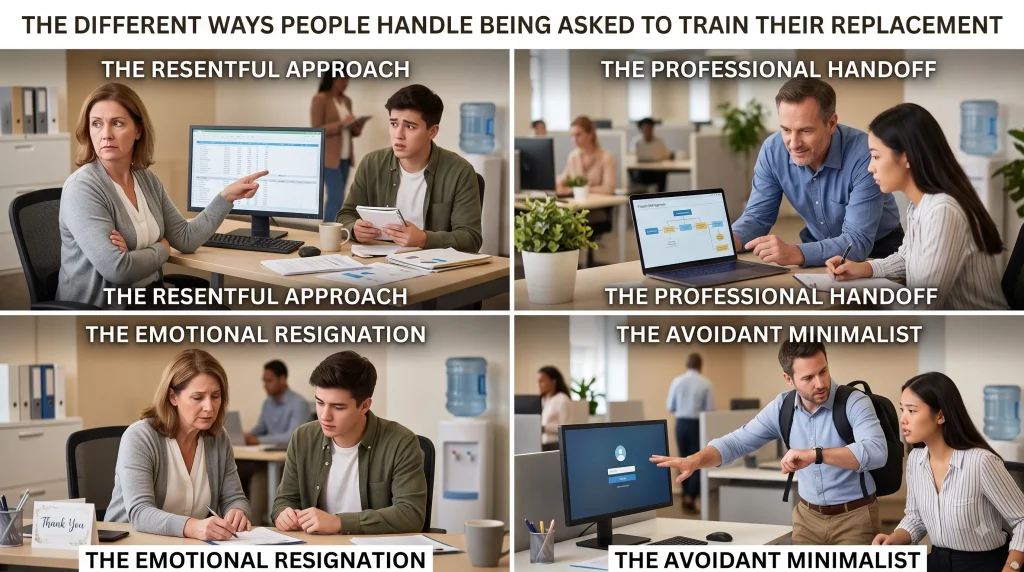
Table of Contents
Why This Moment Brings Out Different Reactions
Training your own replacement sits at an odd intersection — you’re still being paid to do the job well, but you’re doing it for a company you’re actively leaving, for a person who is, in a very literal sense, replacing you. That combination pulls at two different instincts at once: professional pride in doing the job properly, and a very human reluctance to hand over everything you’ve built to someone else without getting anything extra for it. How that tension resolves for you often depends less on how you feel about the company and more on how the exit itself has gone — smooth resignations tend to produce more generous handovers than tense ones.
What This Looks Like Differently for Freshers vs. Professionals
For someone early in their career, training a replacement can feel oddly validating — proof that the role mattered enough to need a proper handover, sometimes the first time a fresher feels genuinely “senior” at something. It can also feel confusing if the replacement is being paid more or was hired faster than expected, without context for why.
For someone more experienced, the calculation is usually more practical. A senior professional often has specialized knowledge that took years to build, and handing that over in two weeks can feel disproportionate — especially if the exit was prompted by feeling undervalued in the first place. Professionals are also more likely to think about how the handover reflects on their reference and professional reputation within the industry, which shapes how much effort actually goes in.
What To Do Instead
- Decide your approach before the first training session, not during it. Reacting moment to moment usually produces the Reluctant Helper pattern by default — a clear plan avoids that.
- Document the essentials in writing, not just verbally, so your effort is visible and doesn’t depend on you being available to answer questions after you’ve left.
- Set a reasonable boundary on your time, especially if the request grows beyond what your notice period reasonably allows — a short, clear conversation with your manager is better than quietly resenting an open-ended ask.
- Keep the tone professional regardless of which type you’re leaning toward — withholding out of frustration can feel satisfying briefly, but it’s a small industry, and how you handled this handover tends to be remembered.
- If you’re asked to stay past your notice period to keep training, treat it as a negotiation, not an obligation — extra time deserves an explicit conversation about what you’re getting in return.
The Line to Remember
How you train your replacement is the last professional impression you’ll leave — and unlike most things in a job, this one is entirely up to you to decide.
If this notice period has you actively looking at what’s next, JobVisitors has real openings worth checking out while you wrap things up here.
FAQs
Am I legally required to train my replacement? In most cases in India, there’s no legal obligation to train a replacement unless your employment contract specifically states it. It’s typically treated as a professional courtesy rather than a binding requirement.
What if my replacement hasn’t been hired yet and I’m asked to write documentation instead? This is common and usually a reasonable request — written documentation benefits whoever eventually takes over the role and takes less ongoing time than live training sessions would.
Should I train a replacement who is being paid more than me for the same role? It’s understandable to feel conflicted, but the training itself and the pay decision are separate issues. If the pay gap bothers you, it’s worth raising directly with HR or your manager rather than letting it affect the quality of the handover.
Is it unprofessional to set limits on how much I train my replacement? No. A clear, reasonable limit — communicated directly rather than through quiet withholding — is a professional way to handle a request that’s grown beyond what your notice period reasonably covers.