Stop Depending on General Coding: The Essential AI Skill-Stacking Guide for 2026
 By Jobvisitors
June 1, 2026
5 min read
By Jobvisitors
June 1, 2026
5 min read
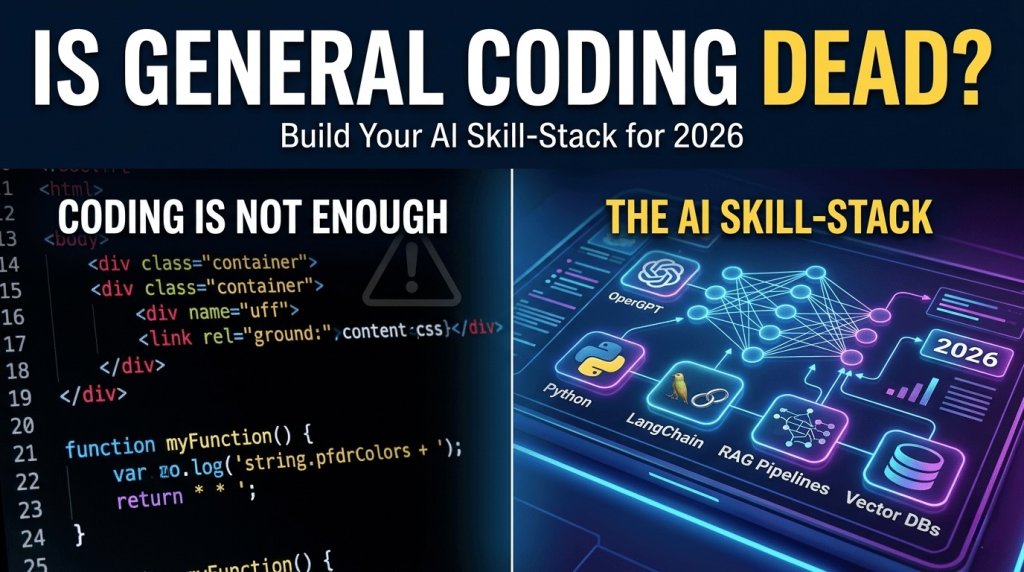
Stop Relying on General Coding: The Critical AI Skill-Stacking Guide for 2026
The software engineering field has crossed a point of no return. If you ’re stepping into the tech workforce or shifting careers mid-path while depending only on the ability to write clean code, you’re working within a borrowed timeframe.
The conventional engineering baseline developing standard CRUD applications, manually fixing syntax errors, and converting simple wireframes into HTML/ CSSis no longer a unique advantage that requires human intervention. Large Language Models, autonomous coding agents, and real-time deterministic software generation have turned raw coding from a high-value skill into an inexpensive commodity.
But this isn’t an apocalyptic essay. It represents a strategic shift. The tech sector is transforming, reallocating budgets swiftly from manual code upkeep to investing billions in applied AI infrastructure, model orchestration, and scalable data pipelines. To stay essential, you need to move beyond being a conventional programmer and embrace the perspective of an AI Orchestrator.
Here’s your complete, production-ready roadmap for assembling a cutting-edge AI skill set poised to deliver maximum value in 2026.
The Core Premise: The Decline of General Coding’s Competitive Edge
For many years, the conventional guidance for entering the tech industry was straightforward: learn a programming language, grasp algorithms, create a personal project, and then apply. Today, that playbook is fundamentally flawed.
When autonomous software development frameworks can rapidly provision standardised environments, produce full structural components, and generate automated unit tests in seconds, the value of individual workers moves upward along the cognitive spectrum.
Freshers and professionals stepping into the job market without prior experience in prompt optimisation, programmatic model guidance, or AI-assisted engineering are inherently at a disadvantage. Recruiters are n’t asking anymore, “ How quickly can you write this loop?” Rather, they inquire: ” How efficiently can you design an autonomous agentic system capable of reliably handling this workflow at enterprise scale?”
To reach this degree of leverage, you need to build upon your core engineering knowledge with specialised architectural skills.
The Step-by-Step Step AI Skill-Stack Architecture
Creating a resilient career in engineering demands proficiency across the layers that bridge foundational computational systems and the user interface. This outlines the essential evolution of tools, frameworks, and architectural approaches you need to master.
Layer 1: Core Execution Foundations
( Python & SQL Though high-level abstraction is the aim, your foundational execution layers must be without flaw.
Python: It continues to be the dominant language in artificial intelligence, machine learning, and data pipelines. You need to move past basic scripting; proficiency in asynchronous execution ( asyncio), object-oriented design, and powerful data manipulation tools like NumPy and Pandas is essential.
Advanced SQL: The strength of AI applications depends entirely on the structured data you provide. You need to grasp how to efficiently query relational databases, optimise joins across multiple tables, and set up raw data stores to serve as core input sources for your intelligent software components.
Layer 2: Context and Memory ( Vector Databases & RAG)
A standalone model lacks awareness of enterprise context or individual user histories. That’s where true engineering value is generated.
Retrieval-Augmented Generation ( RAG): RAG serves as the preferred architectural foundation for enterprise AI solutions. It allows software to retrieve accurate, domain-specific data from external databases, document stores, or live APIs and embed it directly into the LLM’s prompt context prior to execution. This stops the model from generating false information and guarantees factual correctness.
Vector databases like (Chroma, Pinecone, and Milvus) differ from traditional databases by matching concepts rather than strings. You must learn to transform unstructured datasuch as text, PDFs, and source codeinto mathematical coordinate systems known as embeddings. Mastering the ability to index, store, and execute high-speed semantic similarity queries on vector databases is essential for contemporary backend systems.
Layer 3: The Orchestration Layer ( LangChain & LlamaIndex
To manage multi-step tasks like fetching a file, summarising it, verifying it against a database, and triggering an email alert an AI application relies on an orchestration framework.
LangChain: This is the go-to developer toolkit for constructing intricate, agent-driven workflows. It offers the foundational components needed to connect multiple LLM calls, integrate models with external computational tools, and handle state in non-linear applications.
LlamaIndex: Unlike LangChain, which is strong in handling general multi-step workflows, LlamaIndex is specifically designed for efficient data ingestion, sophisticated indexing, and well-structured query interfaces. Proficiency in both enables you to link any enterprise data pipeline to intelligence layers with minimal delay.
Layer 4: Application Deployment & API Design
An AI pipeline designed for enterprise use is of no real value if it remains confined to your local machine. You need to create high-performance gateways to make your intelligent architecture accessible on the web.
FastAPI: Master the art of wrapping your LangChain workflows, model invocations, and database actions into sleek, high-speed asynchronous REST APIs with FastAPI. Its integrated data validation and performance make it the perfect backend engine for delivering AI logic.
Streamlit and UI Prototyping: Getting to market quickly is essential. With Streamlit, you can quickly turn intricate backend Python code into fully functional, interactive web apps often within hours making it ideal for showcasing working proof-of -concepts to engineering teams and stakeholders.
The evolution of the technology ecosystem isn’t a reason to step back, but a call to rise to the occasion. By moving away from generic coding and intentionally prioritising Python expertise, vector database handling, and strong model orchestration tools, you place yourself squarely at the heart of the next major leap in software engineering.
Must Read:
What Is Retrieval-Augmented Generation, aka RAG?
From concept to reality: Navigating the Journey of RAG from proof of concept to production
Must Try:
Jobvisitors Magician AI