
Am I Ghosting Recruiters Without Realizing It? Quick Check
 By Jobvisitors
July 15, 2026
5 min read
By Jobvisitors
July 15, 2026
5 min read
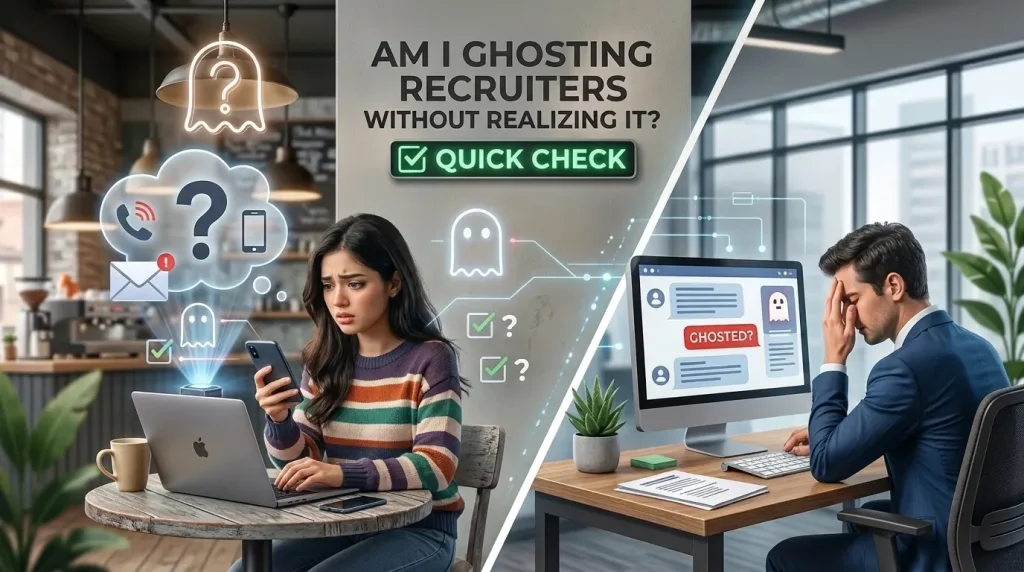
You’ve probably complained about a recruiter going silent on you. Fair enough — it happens constantly. But here’s the uncomfortable flip side: while you’re juggling applications, interview prep, and a dozen open tabs, there’s a real chance you’ve done the exact same thing to someone on the other end, without ever meaning to.
Run through this quick check. If two or more of these sound familiar, you might be ghosting recruiters without realizing it — and it’s an easy thing to fix once you actually notice it.
The Quick Check
☐ You’ve left a recruiter’s email unanswered for over a week, not because you decided against the role, but because it slipped past you in a full inbox.
☐ You’ve accepted another offer and never told the recruiters still actively considering you, leaving them to keep holding a slot open on your behalf.
☐ You’ve missed a scheduled screening call without cancelling or rescheduling — even once.
☐ You’ve stopped responding mid-process after deciding you’re not interested anymore, instead of sending a short “I’ve decided to move in a different direction” message.
☐ You’ve said “I’ll get back to you by Friday” and let Friday pass without following up either way.
None of these make you a bad candidate. They’re almost always a symptom of juggling too many applications at once, not a lack of professionalism. But they add up on the recruiter’s side the same way they’d frustrate you if the roles were reversed.

Table of Contents
Why This Happens So Easily
Job hunting is one of the only processes where you’re expected to run five or six parallel conversations, each with their own timeline, while also doing your actual job or coursework. Recruiters usually have a dedicated system tracking every candidate; you’re doing the same tracking in your head, or in a scattered set of email threads. It’s not that job seekers care less about communication — it’s that the format of a job search makes it unusually easy for one thread to quietly fall through the cracks while you’re focused on the ones that feel most active.
There’s also a smaller, quieter reason: declining or backing out feels like an awkward conversation, so silence can feel like the path of least resistance in the moment — even though it usually creates a bigger mess than a short, honest message would.
- Keep a simple running list of every active application, even a basic spreadsheet with company, role, and last contact date. Most accidental ghosting happens because there’s no visible list, not because of bad intentions.
- Send the two-line decline. If you’re no longer interested, “Thank you for the opportunity — I’ve decided to move forward with another offer” takes fifteen seconds and closes the loop cleanly.
- Cancel calls you can’t make, even at the last minute. A late cancellation is still far better than a no-show with no message.
- Set a personal rule: reply within 48 hours, even if the reply is “I need a bit more time.” A short holding message prevents the appearance of going quiet.
- If you’ve already gone quiet somewhere, send the late message anyway. A delayed “sorry for the silence, I’ve accepted another role” is still worth sending — recruiters remember candidates who close the loop late far better than ones who never do.
A short, honest message costs you almost nothing. Radio silence costs you a relationship you might genuinely want back on the table someday — recruiters move between companies too, and they remember who followed through. That’s really the whole answer to “am I ghosting recruiters”: if you have to ask, a two-line message is usually all it takes to fix it.
If you’re actively juggling multiple applications right now, here’s today’s list of fresh openings on Jobvisitors to help you track what’s actually worth your attention.
Frequently Asked Questions
Is it really a big deal if I don’t reply to a recruiter I’m not interested in anymore? It’s not a career-ending mistake, but it does leave a impression — recruiters often work across multiple companies over their careers, and a candidate who communicates clearly, even to decline, tends to be remembered more favorably than one who goes silent.
What’s the best way to tell a recruiter I’ve accepted another offer? A short, direct message is enough: thank them for their time, let them know you’ve accepted a different offer, and wish them well with the search. There’s no need for a lengthy explanation.
I missed a call by accident — is it too late to fix it? No. Reaching out as soon as you notice, even a day or two late, with a brief apology and a request to reschedule, resolves this in almost every case.
How many active applications is too many to track manually? Once you’re juggling more than two or three at once, most people benefit from writing them down somewhere rather than relying on memory — that’s usually the point where accidental ghosting starts to creep in.