
The 2026 Tech Meta: Freshers’ Hiring Plummeted to 15%And Here’s How to Thrive in the Micro-Team Era
 By Jobvisitors
June 3, 2026
5 min read
By Jobvisitors
June 3, 2026
5 min read
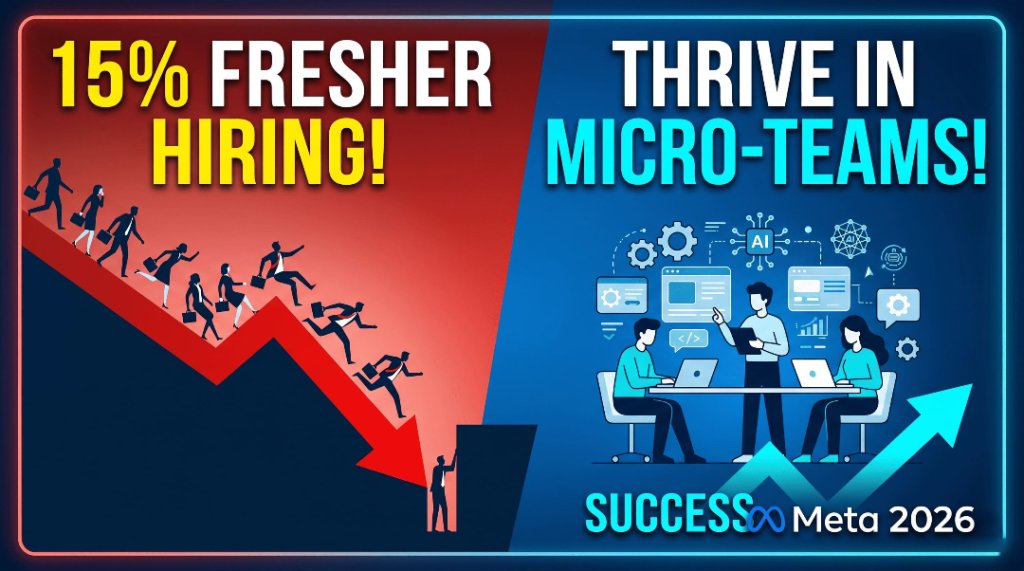
Let’s be brutally honest: the reality of tech fresher hiring 2026 hits entirely different if you are a computer science graduate trying to break into the market.
Over the past ten years, India’s IT industry followed a remarkably consistent pattern: large corporations would recruit thousands of new graduates, provide them with six months of training, and assign them to sizable delivery teams tasked with managing vast legacy systems.
That era is entirely over.
Recent market data shows that hiring of generic tech freshers has dropped sharply to about 15%. But here’s the twist the pessimists aren’t sharing: the tech industry isn’t collapsing it’s going through a major structural transformation.
This is precisely what’s unfolding behind the scenes at major tech companies such as TCS and Infosys, and how you must adjust your strategy to thrive in this evolving environment.
The Demise of the ” Army” and the Emergence of the ” Micro-Team “
Traditionally, major service providers relied on a volume-driven approach. When a client required a large-scale enterprise application to be updated, companies such as Infosys or TCS would assign a 100-person delivery team to manage the frontend, backend, database systems, and manual QA testing.
Today? A 10-person AI-savvy micro-team is rapidly replacing that 100-person army.
Enterprise organizations have come to understand that a compact, highly focused team of engineers equipped with cutting-edge Generative AI tools, LLM coordination platforms such as LangChain, and self-operating debugging systems can produce the same amount of workbut in half the time and with fewer mistakes.
The Vibe Shift: Businesses are shifting away from paying for employee headcount. They are financing leverage. If AI can’t help you boost your output tenfold, you’re essentially a costly burden in today’s tech ecosystem.
The New Math: Emerging Tech Now Rules the Market
As generic developers are being left behind, the door for innovators is being ripped wide open.
The 15% reduction applies solely to legacy technology positions, such as basic Java developers, manual QA testers, and Level 1 support staff. Looking at the raw data, tech roles that are still developing make up more than half of all hiring demand.
The capital hasn’t vanished; it’s merely been redistributed. Once used to fund large teams of standard software engineers, budgets are now actively seeking out:
1) AI/ ML Orchestrators ( professionals skilled at linking enterprise data to LLMs).
2) Vector Database Engineers ( the designers who oversee AI memory).
3) AI Product Managers ( the strategists who grasp both business logic and AI potential).
If you’re a newcomer who knows how to construct a Retrieval-Augmented Generation ( RAG) pipeline, you’re not competing for limited spots in the 15% category. You’re precisely the kind of talent product-led startups and Global Capability Centres ( GCCs) are willing to pay a significant premium for.
How to Break Free from NPC Mode and Build Your Career
To thrive in the age of micro-teams, stop operating like a factory floor worker and begin thinking and acting like an architect. Basic coding is now considered a standard requirement rather than a distinguishing feature.
Your survival guide for the 2026 market
1. Stop spamming skills, start building skill stacks: Knowing HTML, CSS, and basic JavaScript gets you nowhere. You should build a set of skills that generate independent value. Get up to speed with Python, gain expertise in API integrations, and learn how to run open-source AI models on your own machine. You must demonstrate your ability to automate your own workflow.
2. Demonstrate Your Skills in Public: Recruiters no longer prioritize your CGPA; instead, they focus on your GitHub profile and your live, active projects. To join an elite AI micro-team, you must demonstrate that you already possess the skills they have. Launch a functional AI app, share the process on LinkedIn, and strengthen your digital presence.
3. Bypass the Hiring Filter: The biggest challenge in the micro-team era is overcoming the hurdles posed by ATS ( Applicant Tracking Systems). With smaller teams, the filtering becomes vastly more intense. You ca n’t send a generic resume and hope for the best. Each application needs to be precisely customised to match the exact technology stack of the specific micro-team.
Pro Tip: That’s precisely why tools like Magician AI are turning into the secret weapon for Gen Z job seekers you’re not leveraging AI to smartly customise your resume to dodge ATS filters and align with each job posting, you’re already falling behind those who are.
The Final Verdict
The safety net for mass hiring no longer exists, yet the bar for new entrants has never been higher. TCS, Infosys, and global startups are actively seeking out the next generation of engineers who can effectively harness AI, rather than merely writing code.
Adjust to the micro-team trend, master the AI toolkit, and claim the prize. The market is ready for you.
Must Read:
As layoffs cross 1 lakh across tech industry in 2026, here are Al-proof jobs for engineers.
Why 2026 Might Be the Worst Year to Be a Fresher in Tech