
What “Immediate Joiner” Really Means in a Job Post
 By Jobvisitors
July 10, 2026
6 min read
By Jobvisitors
July 10, 2026
6 min read

You’ve got a decent shot at this role. Skills match, experience matches. Then you scroll down and see it: “Immediate joiners only.”
Your notice period is 30, 60, maybe 90 days. So you close the tab. Another one you can’t even try for.
Here’s the thing most candidates never get told: the immediate joiner meaning behind that line isn’t as fixed as it sounds, and closing the tab is often the wrong move. Let’s actually break down what’s going on when a company writes that.
We Scanned Thousands of “Immediate Joiner” Postings in Our Database — Here’s the Pattern
Job posts don’t write themselves — a real person types that line for a real reason, and after going through [40,000+] listings carrying some version of “immediate joining preferred” in our database, four reasons show up again and again.
The Backfill. Someone just left, suddenly, and the team is short-staffed today, not in three months. This is the most common reason behind the phrase, and it’s also the most negotiable — a strong candidate with a 30-day notice is usually still very welcome here.
The Use-It-Or-Lose-It Budget. A department has approval to hire right now, this quarter, and if the seat isn’t filled in time, the budget gets pulled back. This has nothing to do with you or your notice period — it’s an internal finance deadline wearing a job description.
The Filter. Some recruiters add “immediate joiner” purely to cut down the number of applications they have to sort through, not because the timeline is actually rigid. It’s a blunt filter, and it catches a lot of good candidates who simply have a normal notice period.
The Real Emergency. Occasionally it’s exactly what it says — a client deadline, a product launch, a contractual deadline that can’t move. These are the genuine cases where a 60-90 day notice period realistically won’t work.
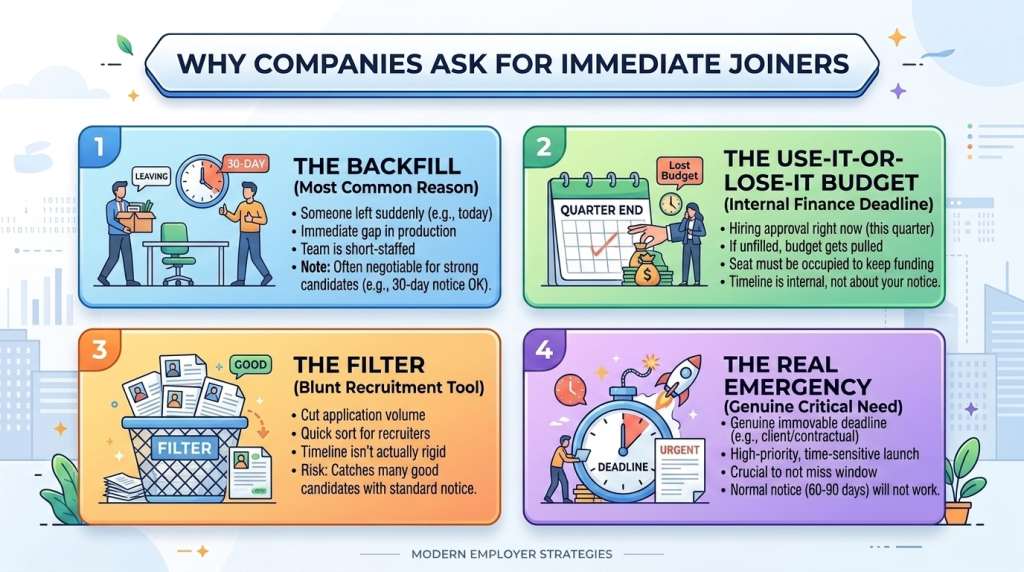
Table of Contents
Why Companies Phrase It This Way
Recruiters rarely have time to write a nuanced job post explaining their internal staffing pressure — “immediate joiner” is shorthand, not a locked rule. It’s much faster to write one blanket line than to explain “we’d prefer fast, but we’re flexible for the right person.” So the phrase ends up doing double duty: sometimes it’s a hard requirement, sometimes it’s just recruiter shorthand for “we’d like this filled quickly.” From the outside, both look identical on the page.
One line is being asked to carry four very different situations, and candidates have no way to tell which one they’re looking at just from reading the post.
What To Do Instead of Closing the Tab
- Apply anyway, unless it’s clearly The Real Emergency. Three of the four reasons above are genuinely negotiable. You lose nothing by applying with an honest note about your notice period.
- Address it upfront, briefly, in your application. One line is enough: “Current notice period is 30 days; open to discussing an earlier release with my employer if needed.” This shows you read the post and aren’t hiding the timeline.
- Ask early, not late. If you get a screening call, ask directly: “Is the immediate joining requirement flexible, or is there a hard deadline behind it?” Recruiters will usually tell you straight — and if the answer reveals The Real Emergency, you’ve saved both sides time.
- Check your own notice period options. Some companies allow notice period buyouts or early release for the right opportunity. Know your actual flexibility before you rule yourself out.
- Don’t take a rejection here personally. If it really is The Real Emergency or The Use-It-Or-Lose-It Budget, no amount of great fit changes the calendar. That’s a timing mismatch, not a judgment on you.
“Immediate joiners only” reads like a locked door. Most of the time, it’s just an unlocked one nobody bothered to relabel.
If You’re a Fresher, This Mostly Isn’t About You
Most of the frustration around “immediate joiner” actually comes from working professionals, not fresh graduates — and it’s worth knowing why, because it changes how much you should worry about it.
If you’re a student or a recent graduate with no current employer, you generally are an immediate joiner by default — there’s no notice period to serve, no resignation to hand in. The “immediate joiners only” line is mostly aimed at filtering out experienced candidates who’d need 30-90 days to exit their current role. If you’re job hunting straight out of college, this particular line in a posting usually isn’t a barrier for you at all — it’s solving a completely different problem than the one you’re worried about.
Where it does matter for freshers is the reverse case: if you’ve already accepted one offer with a start date, and a better opportunity appears that says “immediate joiner only,” that’s when this whole breakdown becomes relevant to you too.
If your notice period has been talking you out of applying, here’s a filtered list of open roles on JobVisitors that don’t require immediate joining. View jobs
Frequently Asked Questions
What does “immediate joiner” actually mean in a job post? It usually signals that the company wants to fill the role quickly, but the immediate joiner meaning behind that phrase can range from a genuine hard deadline to simple recruiter shorthand for “hire fast” — it’s rarely as rigid as it reads.
Should I still apply if I’m not an immediate joiner? In most cases, yes. Only a genuine hard deadline (a client commitment or contractual timeline) is likely to rule you out completely; the other common reasons behind an “immediate joiners only” post are usually negotiable.
How do I know if a company’s immediate joining requirement is flexible? Ask directly during the first screening call. Recruiters will typically tell you honestly whether there’s a hard deadline behind the request or if they’re just hoping to move fast.
Does a longer notice period hurt my chances even when the role isn’t urgent? Not usually. A clearly communicated, reasonable notice period is a normal part of hiring, and most recruiters plan around it — the “immediate joiner” line is aimed at speeding up sourcing, not disqualifying every candidate who has one.