
Beyond the Hype: How Amazon’s $48 Billion Investment Shapes India’s Digital Future
 By Jobvisitors
June 26, 2026
8 min read
By Jobvisitors
June 26, 2026
8 min read
Evaluating the Amazon 48 billion AI investment impact on startups in India , Amazon Chief Executive Officer Andy Jassy’s recent meeting with Prime Minister Narendra Modi in New Delhi culminated in one of the most substantial foreign direct investment announcements in India’s tech history. The technology giant has pledged to invest a staggering $48 billion in India between 2026 and 2030. This monumental commitment, marking a significant leap from previously announced plans, highlights a robust strategy to deepen the company’s footprint in one of the world’s most dynamic digital economies. When combined with previous capital injections since 2010, Amazon’s cumulative investment in India will surpass $88 billion by the turn of the decade. The scale of this financial deployment is not just a corporate milestone; it acts as a catalyst capable of altering the trajectory of the nation’s technological landscape. While mainstream coverage has highlighted the top-line numbers, the micro-economic ripples are where the true transformation lies. From reshaping the entrepreneurial ecosystem to rewiring the logistics supply chain, this initiative encompasses cloud computing, rapid delivery, and substantial workforce welfare programs.
The Core: Cloud & AI Infrastructure
The cornerstone of Amazon’s ambitious blueprint is undoubtedly its aggressive push into artificial intelligence and advanced cloud computing. To grasp the magnitude of this shift, one must closely analyze the Amazon 48 billion AI investment impact on startups. Historically, early-stage technology companies in India faced significant hurdles when attempting to scale complex machine learning applications or deploy massive generative AI models. The computing power required was often housed in overseas data centers, leading to high latency, exorbitant operational costs, and complex compliance challenges regarding data sovereignty.
By dedicating over $21 billion specifically to AI and cloud infrastructure—bolstered by a recently announced $13 billion top-up—Amazon is effectively democratizing access to high-tier computational resources. For a burgeoning startup in Bangalore or Pune, this means the ability to rent top-tier processing power locally. The reduction in operational overhead empowers bootstrapped innovators to experiment, build globally competitive products, and scale rapidly without burning through vast amounts of venture capital on basic infrastructure. This localized capacity ensures that the next wave of Indian fintech, agritech, and healthcare innovations can be hosted securely within national borders, complying seamlessly with local data regulations.
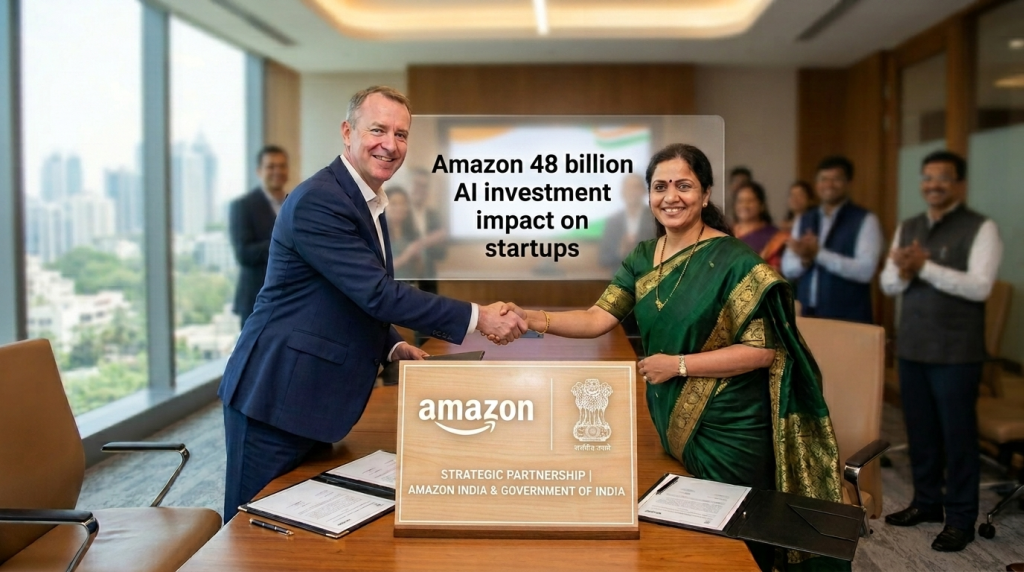
Table of Contents
Solving the Hardware Bottleneck
A critical component of this cloud expansion is hardware. Software innovation, no matter how advanced, is intrinsically tethered to the physical limitations of the processors running it. To address the global compute bottleneck, a primary feature of this investment is the upcoming AWS custom AI chips availability in Mumbai and Hyderabad. As Amazon Web Services (AWS) aggressively expands its data center capacities in these two prominent technological hubs, it brings its proprietary silicon, such as Trainium and Inferentia, directly to the Indian developer community.
These custom-designed chips are specifically engineered to train and deploy complex machine learning models far more cost-effectively than traditional graphical processing units (GPUs). Having these specialized AI chips available natively within domestic servers means developers experience near-zero latency. Consequently, an IT architect designing a regional language voice assistant or a complex predictive analytics tool can significantly accelerate their development cycles. It firmly positions India not just as a consumer of global AI tools, but as an active, high-speed laboratory for next-generation algorithmic development.
The Physical Supply Chain: Reaching the Hinterlands
Beyond the digital ether of cloud computing, Amazon’s strategy heavily fortifies its physical footprint across the subcontinent. The digital economy cannot thrive in isolation; it requires an incredibly robust logistical backbone to translate online clicks into physical deliveries. E-commerce saturation in metropolitan centers like New Delhi and Chennai has prompted retail giants to look toward less urbanized regions for sustained growth.
This strategic pivot is best exemplified by the Amazon quick commerce expansion in Tier 3 cities. The company has officially outlined aggressive plans to launch more than 20 new large-scale fulfillment centers and over 100 new last-mile delivery stations nationwide within this year alone. Quick commerce—the delivery of everyday essentials and retail goods within a matter of minutes or hours—is a highly capital-intensive operational model that demands dense networks of micro-warehouses and ultra-efficient supply chain software. By extending this rapid delivery infrastructure into Tier 3 and Tier 4 towns, Amazon is radically reshaping consumer expectations outside major metropolitan areas. Furthermore, this localized warehousing empowers regional artisans, local weavers, and small-scale manufacturers, integrating them into a hyper-efficient national digital marketplace where their goods can reach buyers across the country with unprecedented speed.
Empowering the Gig Workforce and Future Generations
The rapid expansion of physical logistics naturally requires a massive expansion of the workforce. Recognizing the critical importance of the human element in scaling its operations, Amazon is concurrently investing heavily in labor welfare and long-term employment sustainability. The company aims to support an estimated 3.8 million direct and indirect jobs by the end of 2030.
To safeguard the gig workforce that forms the lifeblood of its rapid delivery network, Amazon is expanding its ‘Sammaan’ program. Supported by a newly announced $300 million operations and associate well-being fund, this initiative provides comprehensive insurance coverage, on-road safety measures, financial inclusion strategies, and crucial educational scholarships for the children of delivery associates. Beyond immediate workforce welfare, Amazon is looking to the future by pledging to bring foundational artificial intelligence education to 4 million students enrolled in government schools. This forward-looking educational initiative is designed to ensure that the nation possesses the skilled human capital necessary to sustain and grow the very digital infrastructure—including the localized AWS custom AI chips availability in Mumbai—that Amazon and other tech giants are currently building.
The Geopolitical and Economic Significance
In the broader geopolitical and macroeconomic context, Amazon’s $48 billion deployment acts as a massive endorsement of India’s economic trajectory. It signals profound international confidence in the country’s business environment, policy framework, and expanding internet penetration. This capital influx does not exist in a vacuum; it arrives amidst fierce competition as global technology titans like Microsoft and Google also announce multibillion-dollar investments to establish their own AI hubs and cloud infrastructure across the nation.
However, Amazon differentiates itself by tightly integrating its cloud supremacy with its vast e-commerce and logistics dominance. The company has set an ambitious target to enable $80 billion in cumulative e-commerce exports by 2030, effectively transforming millions of local small and medium enterprises into global merchants. This multifaceted approach ensures that the capital injection permeates multiple layers of the economy, driving growth from the highly specialized AI developer in a high-tech corporate park to the small-scale vendor operating out of a regional district.
Conclusion
Ultimately, Amazon’s sweeping $48 billion investment spanning from 2026 to 2030 represents far more than just a corporate expansion; it is a foundational pillar for India’s digital future. By aggressively funding both the intangible realm of artificial intelligence and the tangible networks of rapid commerce, the tech giant is setting the stage for unprecedented economic digitization. Whether examining the direct Amazon 48 billion AI investment impact on startups through cutting-edge computing power or witnessing the Amazon quick commerce expansion in Tier 3 cities, the ripples of this capital will be felt for generations. For more granular details and the original coverage of this monumental announcement, you can read the full news article on The Indian Express.
WION Report: Amazon’s $48 Billion Investment & AI Push in India
This broadcast covers the strategic meeting between CEO Andy Jassy and PM Modi, outlining the broader implications of the investment on cloud infrastructure, the local economy, and the overarching Amazon 48 billion AI investment impact on startups.
Frequently Asked Questions (FAQs)
1. What is the total amount Amazon is investing in India?
Amazon has committed to a massive $48 billion investment in India between the years 2026 and 2030. When combined with its prior commitments, the company’s total cumulative investment in the country since 2010 will exceed $88 billion.
2. How much of the investment is dedicated to AI and cloud computing?
A significant portion of this capital is targeted at digital infrastructure. Over $21 billion has been specifically earmarked to expand artificial intelligence capabilities and Amazon Web Services (AWS) cloud infrastructure across the nation.
3. Will this investment create new jobs in India?
Yes, employment generation is a primary pillar of this initiative. By 2030, Amazon aims to support approximately 3.8 million direct and indirect jobs across its e-commerce, cloud computing, and logistics networks.
4. How will this benefit Indian students?
As part of its long-term strategy to build future-ready human capital, Amazon has pledged to introduce artificial intelligence education and foundational digital literacy programs to 4 million students currently enrolled in government schools.
5. What is the Sammaan program mentioned in the expansion?
The Sammaan program is a comprehensive welfare initiative dedicated to Amazon’s delivery associates. It includes benefits like extensive health insurance, road safety initiatives, financial inclusion programs, and educational scholarships for the children of gig workers.