What to Do When You’re Feeling Behind After Seeing a Promotion Post
 By Jobvisitors
August 24, 2026
5 min read
By Jobvisitors
August 24, 2026
5 min read

The Moment a Batchmate’s Promotion Post Shows Up on Your Feed
You’re scrolling for no particular reason, and then there it is — someone you graduated with, or worked alongside two jobs ago, announcing a new title with a string of celebratory comments underneath. That feeling behind after seeing a promotion post hits before you’ve even finished reading the caption.
How People Actually React to This Moment
The Immediate Profile Check. Within seconds, your own profile is open in another tab. You’re re-reading your last update date, your current title, comparing timelines you’d otherwise never think to compare.
The Overachiever Spiral. You close the app and immediately start looking at certification courses, job postings, or “skills to learn in 2026” articles — a burst of motivated energy that’s really more about proving something to yourself than a real plan.
The Silent Mute. You don’t unfollow, that feels dramatic, but you quietly mute their updates. Not out of dislike for them specifically — just to stop the feed from doing this to you again next week.
The Performed Congratulations. You leave a comment that reads warmly — “so well deserved!” — while the actual feeling underneath is closer to a knot in your stomach than genuine celebration. Both can be true at once, and neither cancels the other out.
Most people cycle through two or three of these within the same ten minutes, not just one.
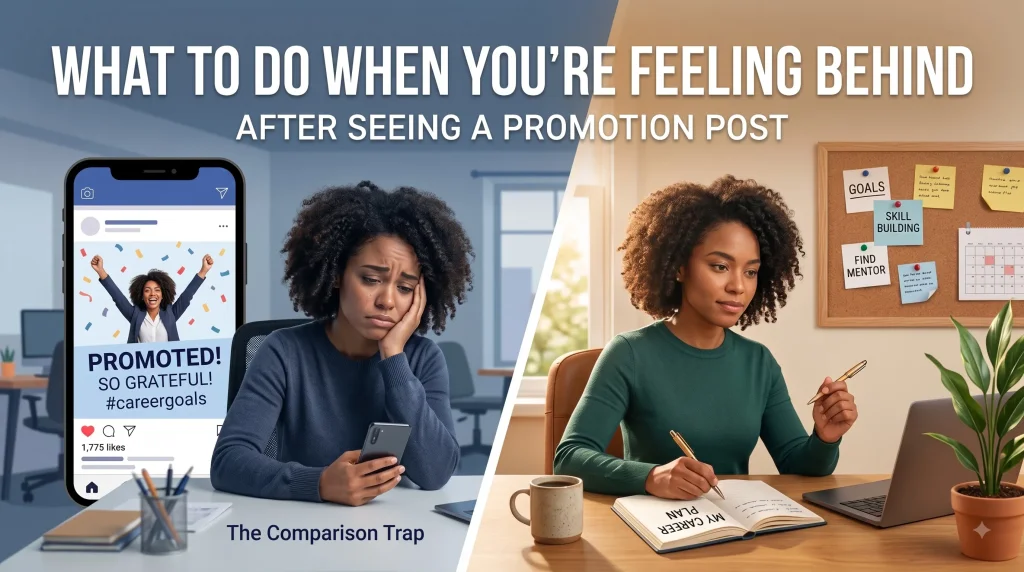
Table of Contents
Why This Hits Harder Than It Should
A promotion post isn’t really information — you didn’t need to know this to do your job today. What makes it land is that it arrives as an unplanned checkpoint, comparing your timeline against someone else’s without your consent. The post shows the outcome — new title, new photo, congratulatory comments — with none of the context: how long they’d been angling for it, what trade-offs they made, whether they’re actually happy about it a month later. The comparison your brain runs isn’t fair, because you’re comparing your whole, complicated reality against someone else’s single highlight, but that unfairness doesn’t stop the feeling from showing up.
Freshers vs. Professionals: Why the Sting Is Different
For a fresher, this moment often triggers comparison against a very short timeline — a batchmate’s first promotion eighteen months into their first job can feel like proof you’re already behind, even though eighteen months is barely enough time to establish a real track record either way.
For a professional several years in, the comparison tends to be more specific and personal — not “am I behind in general” but “why not me, at this company, doing similar work.” That specificity is what makes it sting more precisely, even if it fades faster once the initial reaction passes.
What To Do Instead
- Let the first reaction happen without acting on it. The profile check, the spiral, the mute — none of these are wrong, but doing them immediately after seeing the post means you’re reacting to a feeling, not making a decision.
- Separate “I feel behind” from “I am behind.” One is an emotional response to a single data point. The other would require actually comparing your full situation, which a two-line post can’t tell you anything about.
- If the feeling keeps recurring, treat it as information about you, not about them. A repeated reaction to seeing others’ progress is often a signal that something in your own work has felt stagnant for a while — worth sitting with honestly, separate from this specific post.
- Mute if muting genuinely helps, without guilt. Curating what you see regularly isn’t pettiness — it’s a reasonable way to manage a feed that isn’t designed with your wellbeing in mind.
- If it turns into real motivation, act on the plan, not the panic. A course or a job search started after a calm week is more likely to stick than one started in the ten minutes right after a scroll.
The scroll shows you one line of someone else’s story — not enough to measure your own against, no matter how convincing it feels in the moment.
Worth a Look While You’re Here
If this feeling keeps circling back to “maybe it’s time for something new,” that’s worth listening to on its own terms — not because of someone else’s post, but because it’s what you actually want. JobVisitors has real openings worth a look when you’re ready.
Common Questions
Is it normal to feel jealous of a colleague’s promotion even if I like them? Yes. Liking someone and feeling a comparison sting at their success aren’t contradictory — both reactions can happen at once, and neither one says anything bad about you or the relationship.
Should I say something if I genuinely feel happy for them but also a little behind? You can hold both feelings privately without needing to resolve them before commenting. A genuine “congratulations” doesn’t require you to have fully processed your own feelings about your own career first.
Is muting someone on social media a sign I have a problem with them? Not necessarily. Muting is often about managing your own feed and headspace, not about the other person specifically — most people who do it never mention it, and the other person is unlikely to know or be affected.
How do I know if this feeling means I should actually make a career change? A single reaction to one post isn’t a reliable signal on its own. If the same feeling shows up repeatedly over weeks, independent of any specific trigger, that’s a better sign it’s worth exploring seriously rather than reacting to in the moment.