Sharing Your Offer Letter Screenshot With Friends? Wait
 By Jobvisitors
July 31, 2026
4 min read
By Jobvisitors
July 31, 2026
4 min read

Priya got her offer letter on a Friday evening. Genuinely thrilled, she screenshotted the whole thing — role, salary, joining date — and sent it straight to her close college friends’ group, six people she’d trust with anything.
Two weeks later, before she’d even resigned from her current job, her manager casually mentioned knowing about the new offer — including the exact number. One of those six friends had forwarded the screenshot to her own boyfriend, who happened to work at Priya’s current company, in a completely different team. He hadn’t meant any harm by it — just mentioned it in passing to a colleague, who happened to know Priya.
Nobody in that chain was trying to hurt her. That’s exactly what makes sharing your offer letter screenshot with friends such an easy mistake to make, and such a hard one to trace back once it’s already happened.
Why This Feels Completely Safe in the Moment
A close friend group chat feels like a sealed room — you know everyone in it, you trust them individually, and sharing genuinely exciting news feels like exactly what the group is for. What’s easy to forget is that a screenshot, once it leaves your phone, has zero built-in containment. It doesn’t matter how much you trust the six people you sent it to; the moment it exists as a forwardable file, it only takes one of them sharing it with one more person, with entirely good intentions, for it to travel somewhere you never intended.
This is different from just telling people verbally. A spoken conversation naturally fades and loses detail as it gets retold. A screenshot doesn’t — it carries every exact figure and detail intact, no matter how many hands it passes through.
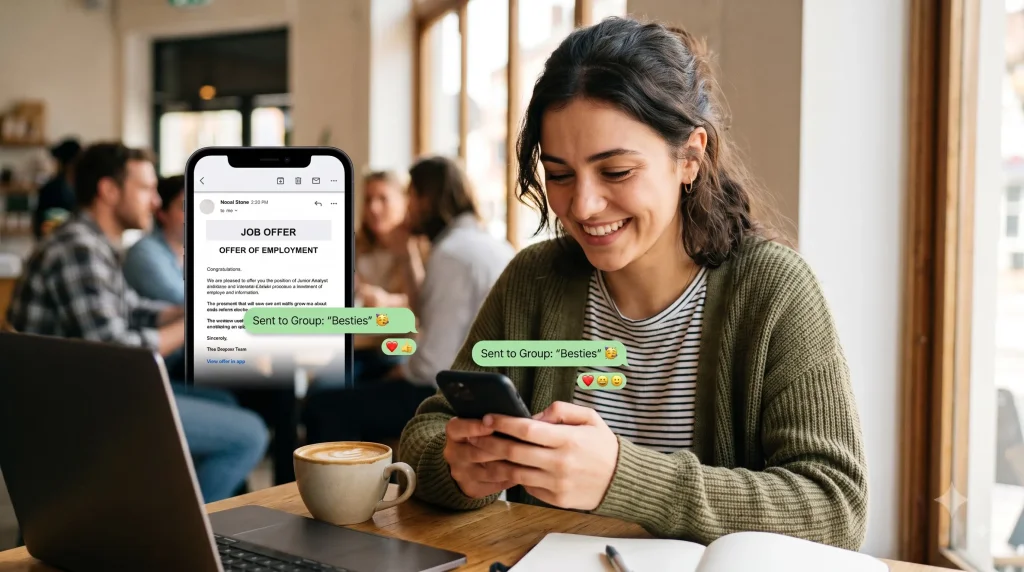
Table of Contents
What To Do Instead
- Share the news, not the document. Tell your friends you got a great offer, even name the company and role if you want — just leave the actual letter, and the exact number, out of what you forward.
- Assume any screenshot could travel three people further than you intended. This isn’t about distrusting your specific friends — it’s about recognizing that a digital file has no natural way to stay contained once it exists outside your own device.
- Remember how small your professional world actually is. Industries, colleges, and cities create far more overlapping connections than feels obvious in the moment — a friend’s partner, a cousin’s colleague, a former classmate, are all closer to your current workplace than you’d guess.
- If you do want to show someone the actual letter, do it in person, on your own phone. This keeps the document itself from ever becoming a forwardable file in the first place.
- If it’s already happened, address it directly and calmly. If sensitive information has already reached somewhere you didn’t intend, a brief, honest conversation with whoever needs context is usually far more effective than trying to control or trace exactly how it spread.
Being excited about an offer is never the problem. It’s the specific, forwardable form the excitement takes that quietly turns a private win into information you no longer control.
If you’re gearing up for your next offer and want to keep the details exactly where you choose, here are today’s fresh openings on JobVisitors
Frequently Asked Questions
Is it wrong to share my offer letter with close friends? It’s not wrong exactly, but sharing the actual document carries more risk than most people realize — once it exists as a screenshot, you lose control over where it travels next, regardless of how much you trust the people you first sent it to.
What should I do if my salary details have already been shared without my permission? A direct, calm conversation with anyone who now has that information — asking them to keep it private going forward — is usually the most effective response, rather than trying to trace or undo the sharing itself.
Is it safer to just tell people verbally instead of sending a screenshot? Generally, yes. A verbal mention naturally loses precision as it’s retold, while a screenshot carries the exact details intact no matter how many times it’s forwarded.
How likely is it that shared salary information actually reaches my employer? It’s impossible to predict precisely, but professional and social circles overlap more than most people expect — a friend’s partner, cousin, or former classmate can be closer to your workplace than you’d assume, which is exactly why caution is worth the small effort.