


The harsh reality of the Oracle layoffs 2026 began like any other workday. Imagine waking up at 6:00 AM, pouring your morning coffee, and opening your laptop only to find a blunt, impersonal email from “Oracle Leadership” waiting in your inbox. For thousands of employees across the United States, India, Canada, and the rest of the globe, this nightmare became a reality earlier this year. The message was devastatingly brief: “After careful consideration of Oracle’s current business needs, we have made the decision to eliminate your role as part of a broader organisational change. As a result, today is your last working day.”
Behind closed doors and corporate buzzwords like “strategic shifts” and “operational efficiency,” a harsh reality is hitting the global tech industry. Over the past fiscal year, Oracle has quietly eliminated around 21,000 jobs worldwide. If you are wondering exactly how massive that is, it represents roughly 13% of their entire global workforce—bringing their total headcount down from 162,000 in May 2025 to just 141,000 by May 31, 2026.
While investors obsess over stock prices and massive cloud infrastructure deals, thousands of talented professionals are facing the real-world, life-altering consequences of the Oracle layoffs 2026. So, why is one of the world’s most recognized and profitable technology companies shedding so much of its human talent? And more importantly, what does this aggressive restructuring mean for the future of tech jobs globally?
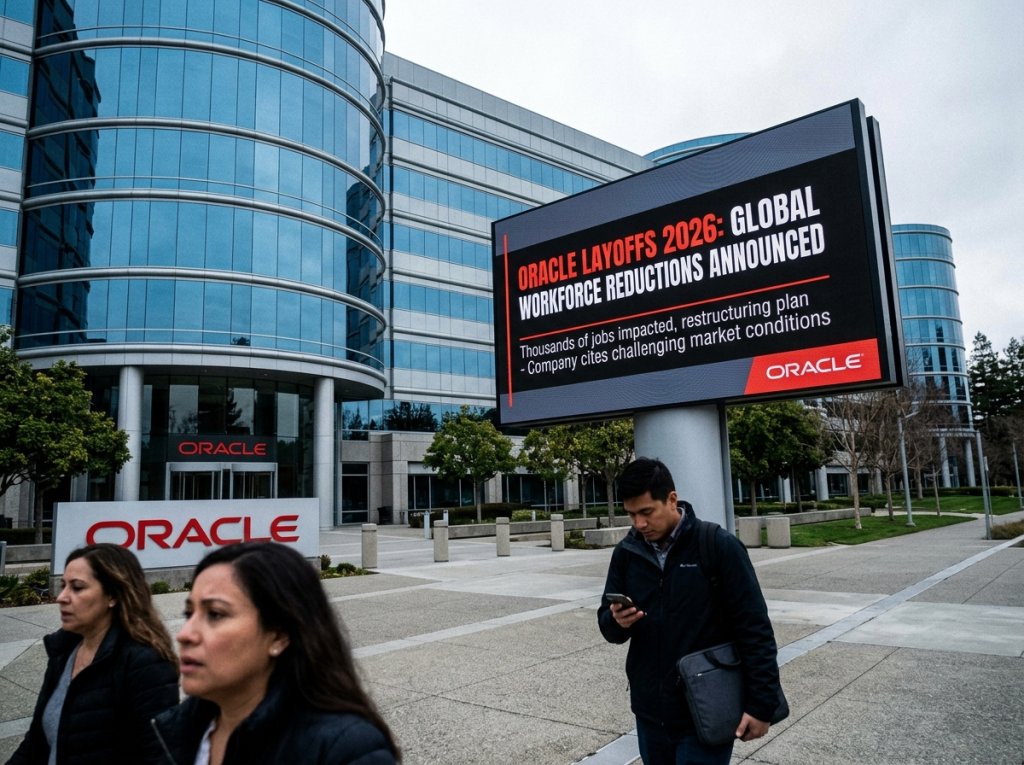
Table of Contents
Why Is Oracle Cutting So Many Jobs? The Billions Behind the AI Pivot
To put it simply: the company is making a multi-billion dollar, all-or-nothing gamble on the future.
The Oracle AI pivot is the primary driver behind this massive Oracle restructuring. The technology giant is currently locked in a fierce, high-stakes battle with titans like Amazon, Google, and Microsoft to dominate the rapidly expanding artificial intelligence infrastructure space. In a sobering admission within their recent annual SEC filing, Oracle explicitly stated that they are literally automating their own internal functions using artificial intelligence, which directly led to many of these Oracle job cuts. Furthermore, they warned that AI could lead to even more workforce reductions in the future.
Under the aggressive leadership pushing the Larry Ellison Oracle restructuring, the company is burning massive amounts of cash to build colossal AI data centers worldwide. A prime example of this is their involvement in the highly publicized “Stargate Project” in collaboration with OpenAI. Oracle expects its capital expenditures for the 2027 fiscal year to reach a staggering $70 billion just to keep up with the explosive demand for AI computing power.
However, there is a catch. Unlike competitors like Microsoft and Amazon, which generate massive, self-sustaining cash flows to fund their AI dreams, Oracle is feeling the financial strain. To fund this $70 billion expansion, Oracle plans to raise an additional $40 billion through debt and stock issuances. Unfortunately, when a company needs to free up capital that aggressively, shrinking the human payroll is often the first lever executives pull. They are literally taking the money saved from firing human workers and redirecting it into building AI data centers.
The Financial Reality: Severance and the True Cost of Restructuring
When you look closely at the financial filings, the sheer scale of this corporate restructuring is breathtaking.
- The Cost of Severance: Oracle spent an eye-watering $1.84 billion on severance packages and other exit costs related to restructuring activities during fiscal 2026. To give you some context on how drastic this pivot is, they spent only $374 million on similar severance costs the previous fiscal year. This five-fold increase shows how aggressive the cuts have been.
- The Severance Package Itself: For the thousands of individuals who received those dreaded 6 AM emails, the financial cushion was standard but strictly capped. Reports indicate that US employees were generally offered four weeks of base salary for their first year of employment, plus one additional week for every subsequent year worked, maxing out at 26 weeks. While helpful, it offers cold comfort to veteran employees navigating a brutal tech job market.
The Global Impact: India and Oracle Health Take Massive Hits
This was not just an American corporate event; it was a deeply global reduction. The cuts devastated teams around the world, with certain regions and divisions bearing the brunt of the pain.
- The India Layoffs: Reports indicate that the layoffs hit Oracle’s India operations exceptionally hard. An estimated 10,000 jobs were cut in the country. This amounts to roughly 20% of Oracle’s entire 50,000-strong Indian workforce. This included heavy hits to divisions like Oracle Financial Software Services (OFSS), which reportedly lost about 1,000 jobs, or 10% of its specific headcount.
- Internal Divisions: Beyond regional cuts, internal divisions faced massive overhauls. Research and Development (R&D) saw deep absolute cuts, alongside severe reductions in Sales and Marketing. Additionally, the Oracle Health division (formed largely after the high-profile acquisition of healthcare tech firm Cerner) was reportedly gutted as Oracle integrated and streamlined operations.
What This Means for the Future of Cloud Computing Jobs
If you currently work in the tech industry, the Oracle layoffs 2026 should serve as a stark, undeniable wake-up call. The popular, optimistic narrative that AI will only create new jobs without destroying old ones is being actively challenged in real-time. Oracle’s own legal admission—that deploying AI technologies across its operations actively resulted in workforce reductions—proves that even highly educated, highly skilled tech workers are deeply vulnerable to automation.
The broader industry numbers are just as grim. According to the layoff-tracking website Layoffs.fyi, by mid-2026, nearly 200 tech companies had already laid off roughly 120,000 employees. The era of hyper-growth and bloated software engineering teams appears to be over.
As Oracle aggressively transitions from a traditional, legacy database company into an AI-first, hardware-heavy juggernaut, Oracle cloud computing jobs are morphing. The corporate demand is shifting drastically away from traditional software development, basic sales roles, and mid-level management. Instead, companies are hiring aggressively for specialized AI infrastructure, physical hardware management, large language model (LLM) training, and high-level, complex cloud architecture.
For the 21,000 individuals who abruptly lost their livelihoods via a morning email, this strategic pivot is a painful, life-altering transition. For the rest of the technology industry, it is a glaring, multi-billion-dollar signal that the artificial intelligence revolution comes with a very real, very heavy human cost. Surviving the next decade in tech will require constant upskilling, adaptability, and an acute awareness of where the massive tech giants are quietly moving their money.
Surviving the Aftermath of the Oracle Layoffs 2026
Ultimately, the Oracle layoffs 2026 represent a historic turning point rather than just a routine corporate downsizing. For tech professionals, the lesson here is that relying on legacy software skills is no longer enough to guarantee job security in an AI-dominated landscape. As we look back on the devastating scope of the Oracle layoffs 2026, it becomes crystal clear that the cloud computing industry is fundamentally evolving. To survive this transition, tech workers must prioritize continuous upskilling and adapt to a new era where even the engineers are competing with the algorithms they helped build.