
Flipkart GRiD 8.0: Everything You Need to Know Before You Register
 By Jobvisitors
June 30, 2026
7 min read
By Jobvisitors
June 30, 2026
7 min read
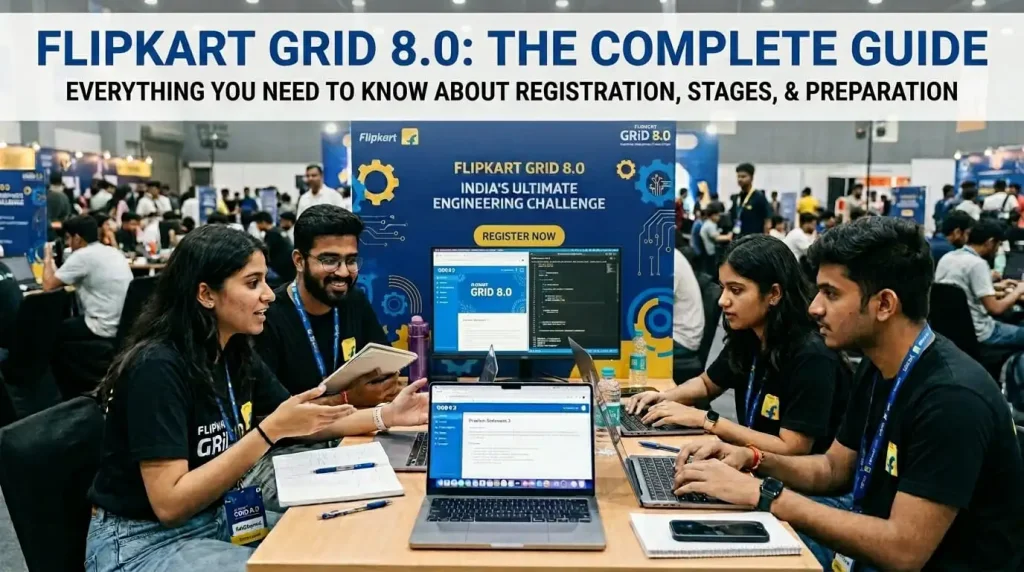
If you’re an engineering student scrolling through your college WhatsApp groups right now, chances are someone has already dropped a link about Flipkart GRiD 8.0. And honestly, the buzz is justified. This isn’t just another coding test you forget about a week later — it’s one of those competitions that actually shows up on your resume and opens doors at one of India’s biggest tech companies.
I went through the official details, eligibility rules, and past winner stories so you don’t have to dig through five different websites. Here’s the full breakdown.
What Exactly Is Flipkart GRiD 8.0?
Flipkart GRiD 8.0 is the eighth edition of Flipkart’s flagship campus engineering challenge. What started years ago as a straightforward coding contest has now grown into something much bigger — a nationwide hunt for tech talent across three different specializations.
Unlike a regular exam where you study a syllabus and write answers, GRiD 8.0 asks you to actually build things. Think real e-commerce problems — the kind Flipkart’s own engineers deal with daily, like handling millions of orders, recommending products, or designing systems that don’t crash during a flash sale. You get a taste of that.
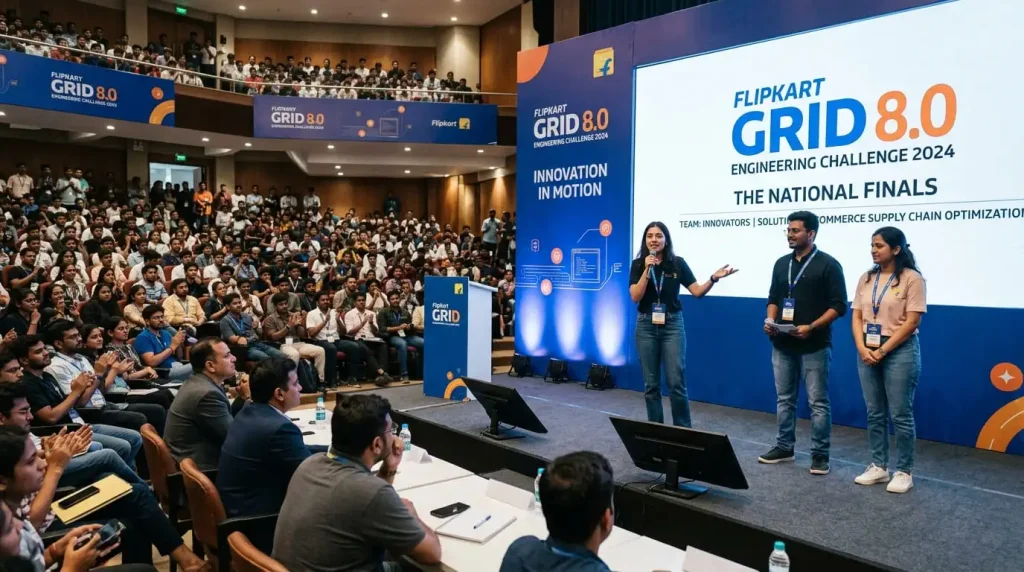
Table of Contents
The Three Tracks Explained
This is where GRiD 8.0 feels different from older editions. Earlier, it was mostly about software development. Now there are three separate paths, and you can apply to all of them at once:
Software Development Track — This is for the classic coders. Expect questions around data structures, algorithms, system design, and how to build backend systems that don’t fall apart under load.
AI Engineering Track — For students who’ve been playing around with machine learning models, fine-tuning, or even working with large language models. This track checks how well you can actually deploy AI, not just talk about it in theory.
Data Science Track — If numbers and patterns excite you more than code, this one’s for analyzing data and pulling out insights that matter for business decisions.
A smart move here is registering for more than one track since the shortlisting happens separately for each. So even if you don’t clear one, you’ve got another shot.
Who Can Apply for Flipkart GRiD Registration?
The good part about Flipkart GRiD registration is that it’s genuinely open. There’s no college-tier filter, no “only top institutes” rule. If you’re studying B.Tech, B.E., M.Tech, M.E., M.S., PhD, or an integrated/dual degree from a recognized Indian college, you’re eligible. Different graduation batches are accepted too, so both third-year and final-year students can take part — third years usually get considered for summer internships, while final years are looked at for full-time roles and winter internships.
And yes, it’s completely free. No registration fee, no hidden charges, nothing. If anyone messages you asking for money in the name of GRiD, that’s a scam, not Flipkart.
How the Competition Rounds Work
Flipkart GRiD 8.0 isn’t a one-shot test. It runs across four stages, and each one acts like a gatekeeper for the next:
- Profile Screening — Your academic record, achievements, and overall profile get evaluated first.
- Online Assessment — A proctored coding or aptitude round depending on your track.
- Case Study / Build Round — This is where things get interesting. You actually build a working solution or prototype.
- Grand Finale — The cream of the crop gets flown to Flipkart’s Bangalore headquarters, all expenses covered, to present in front of real judges.
Even if you don’t make it to the finale, qualifying for earlier rounds gets you a certificate you can put straight on LinkedIn. That’s not nothing — recruiters notice these things.
Flipkart GRiD 8.0 Last Date and Important Timeline
Registrations for this edition opened on 19 June 2026, and the Flipkart GRiD 8.0 last date to apply is 7 July 2026, 11:55 PM. If you’ve been putting it off, don’t wait until the final night — competition portals tend to slow down badly when traffic spikes close to a deadline, and the last thing you want is a failed submission because of server lag.
What Do You Actually Get Out of It?
Beyond the obvious resume value, here’s what past participants say made it worth their time:
- Direct Pre-Placement Interviews for SDE roles and internships
- Certificates for every round you clear, not just the final one
- Top 50 performers get featured across Flipkart’s platforms
- A genuinely useful learning experience, even if you don’t win
One past winner mentioned that what stood out wasn’t the prize money but the real exposure to how a massive tech company actually solves problems at scale. That kind of practical experience is hard to get from classroom projects alone.
Tips Before You Register
A few things worth doing before you hit submit:
- Apply across all three tracks since each one is evaluated independently
- Keep your coding basics sharp, especially data structures and algorithms, regardless of which track you pick
- For the case study round, judges have repeatedly said they value a clear, working solution over an overly complicated one
- Double-check every academic detail you enter, since incorrect information can get you disqualified instantly
Flipkart GRiD Previous Year Questions: What to Expect
A lot of students search for Flipkart GRiD previous year questions before they even finish registering, and that’s honestly the smartest first step you can take. Going through how past editions were structured gives you a realistic idea of difficulty, instead of walking in blind.
From what past participants of GRiD 6.0 and GRiD 7.0 have shared, the online coding round is usually 90 minutes long with three DSA-based questions — generally one tough question and two of medium difficulty. You’re allowed to code in C, C++, Java, or Python, so stick with whichever language you’re fastest in rather than switching just because it “looks better.”
Here are some of the recurring topics that have shown up across previous Flipkart GRiD coding questions:
- Arrays and Strings — problems like finding subarrays with a given sum, or rearranging strings into anagram groups
- Two Pointers — frequently used in palindrome-related string problems
- Greedy and BFS — one repeated pattern is the classic “minimum jumps to reach the end of an array” type question
- Dynamic Programming — both memoization and tabulation approaches have come up, especially in array and string optimization problems
- Graphs and Grids — questions involving navigating an m×n grid, similar to warehouse or delivery-route simulations, have appeared more than once
- Trees — particularly around category hierarchies, which makes sense given Flipkart’s e-commerce catalog structure
Beyond pure coding, past editions have also included a few technical and conceptual questions touching on binary search, sorting algorithms, and basic data structure theory — so it’s worth brushing up on fundamentals even if you’re confident with competitive programming.
If you’re preparing for Flipkart GRiD 8.0 previous year questions style problems, a good approach is to pick up beginner-to-medium level problems from any coding practice platform and time yourself strictly at 30 minutes per question. That mirrors the real pressure of the actual round far better than solving problems without a clock.
After the coding round, things shift completely. Round 3 hands you a real business-style case study — something tied to Flipkart’s actual operations, like improving recommendations or optimizing logistics — and you’re judged on how practical and well-explained your solution is, not how complicated it sounds. Multiple past finalists have specifically mentioned that simple, working solutions beat over-engineered ones almost every time.
One small but useful tip from someone who went through GRiD 7.0: the platform usually only tells you “passed” or “failed” for each question rather than showing partial test case results, so testing your code against edge cases yourself, before submitting, matters a lot more than it sounds.
Final Thoughts
Flipkart GRiD 8.0 is shaping up to be one of the bigger opportunities for engineering students this year, especially with the added AI and data science tracks widening the scope beyond just software roles. Whether or not you make it to the national finals, it’s the kind of competition that pushes you to actually apply what you’ve learned instead of just memorizing it for exams.
If you’re eligible, there’s really no good reason to skip it — it costs nothing, takes a bit of your time, and could genuinely change how your placement season turns out.